
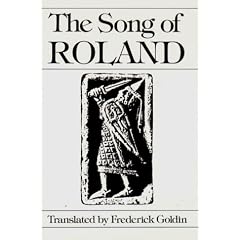
 The version I read was translated by Frederick Goldin. Surprisingly, the piece was easy to read. I never thought I could finish it in a day, given the time I 'allotted' myself to reading for two literature classes and others. I was expecting it to be as difficult to understand as "The Iliad" by Homer. Speaking of "The Iliad," there are big similarities. Both stories revolve around war, except that for "The Song of Roland," Charlemagne of France is on a quest to conquer Spain, with Saragossa the last city standing.
I am reading this for my medieval literature class, and yes, it really has the medieval elements. One noticeable element would be Christianity. Charlemagne and his man are like God's servants, converting pagans, and killing them if they resist. There are even some parts in the story where angels would appear. In parts where Charlemagne dreams, I would say it could be God's message to him. At the end of the story, it is implied that Charlemagne's life revolves around being God's servant.
With the revolving around war, there are great details with regards to it. There are some parts, which seems to be in a pattern. Towards the end where a traitor is sentenced to death, the guilty had his appendages pulled apart by horses, which I would say is one of the methods of punishment during that time. Also, the soldiers swear great loyalty to their lords. Some aspects of feudalism is seen, with the authorities addressed as 'lord' or 'baron'. Terms such as fief and serf were also mentioned.
As for women's role in the story, it is also unnoticeable. The only two women in the story were Aude, Roland's bride-to-be, and Bramimunde, the queen of Saragossa. For Aude, upon hearing the news of her groom's death, she died of grief. Sorry, nothing chivalric here. I would say Bradimunde was spared by Charlemagne. In the end, she became a Christian convert, but in the middle of the story, there are signs that she renounces paganism, after the cruel fate her people experienced.
I would not consider Roland as the main character in the story. He is indeed a key player in the story, but he is not the star of the show. Charlemagne is the star of the show. Also, the King of Saragossa is not the real enemy, but rather one of Charlemagne's men. The King of Saragossa somewhat plays the same role as Roland, a key player in the story. Without these two characters, it would not be the story we know.
If anyone wants to pursue medieval literature, "The Song of Roland" is a nice piece to start with. As I have mentioned, do not expect chivalry in this literary work. Besides, the medieval age was a cruel one. Romance was added to give it softness. It was still a man's world back then.


No comments:
Post a Comment